Date
10-10-2026
Integrated into India after the 1971 war, Turtuk and surrounding Chorbat Valley villages form a unique borderland. Predominantly Balti-speaking, the community practices Sofia Noorbakshia—a distinctive Sufi Islamic order combining Sunni and Shia jurisprudence. Despite strategic importance of the terrain, rather than drawing nuanced attention of the state, the residents face political underrepresentation and cultural erasure. Families remain split across the Line of Control, yet preserve their Tibetan-derived linguistic heritage, which bridges their Islamic faith and ancestral past. To ensure sustainable development and national integration without assimilation, local demands focus on official recognition for the Balti language under the Sixth Schedule, political representation in Ladakh’s governing bodies, and regulated tourism to protect the community’s unique identity and socio-economic resilience.
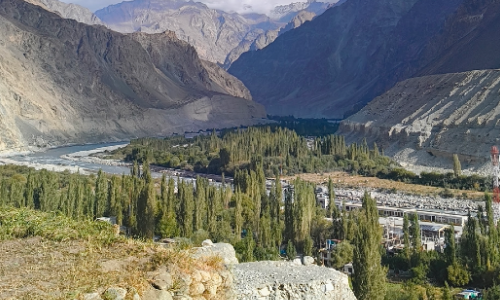
Turtuk is geographically part of India, yet culturally, it is rooted in the broader historical and civilizational space of Baltistan. Its residents speak Balti, maintain traditions that are distinct from those of much of Ladakh, and predominantly belong to the Muslim community, including adherents of the Noorbakshia sect. A recent visit to Turtuk underscored that the story of this border village cannot be understood merely through the prism of security or geopolitics. Its history and contemporary reality are equally shaped by questions of identity, memory, cultural heritage, and belonging, reflecting the complex human dimensions of life in a borderland.
Historical Context and the Legacy of 1971
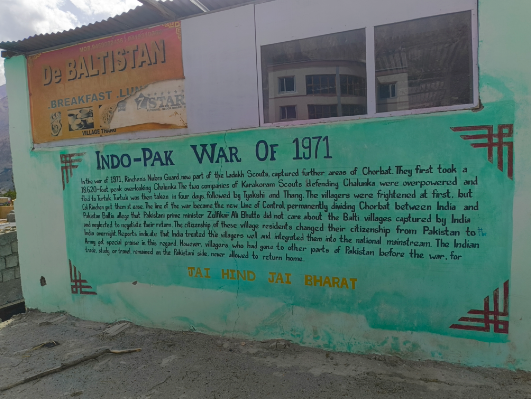
Before 1971, all the Balti villages in the Chorbat valley were part of Baltistan. In 1971, Indian army under the leadership of Colonel Chewnag Rinchen[1], known famously as the “Lion of Ladakh” spearheaded the legendary Battle of Turtuk leading the Ladakh Scouts and local volunteers in subzero temperatures to take control of this highly strategic region of Baltistan and brought it under Indian administration overnight. He played a pivotal role in integrating the four Balti villages namely Chalunka, Turtuk, Tyakshi and Thang into India. It has to be noted that these villages where under Pakistani control for 23 years since 1948 and were part of the Baltistan area (historically part of the Chorbat Valley) in what was then known as Northern Areas in Pakistan. The residents stayed on in these villages, while the political boundary changed around them. Families and communities that had historically belonged to the same cultural and linguistic family for centuries in a definite geographical terrain, first in the princely state of Jammu and Kashmir and then under Pakistani control, suddenly found themselves separated from their co-ethnics by the Line of Control, which was for them, a de facto international border. Contemporary accounts continue to describe families divided across the Line of Control and the emotional consequences of that separation. This history is essential to understanding the people of Turtuk today. They are not simply a “border population”. They are a Balti community whose cultural history predates the present political boundaries.
One of the most striking features of Turtuk's history is the suddenness with which political geography entered ordinary people's lives. Historical accounts describe how residents of Turtuk and surrounding villages woke up one fine morning, after the events of December 1971 to find themselves living under a different administration and a different state. Families who had previously moved between villages, traded with one another and maintained relationships across the region now found themselves separated by a new line of division. Conversations with locals inevitably acquaint one with several touching tales of how members of the same families were separated from one another by the turn of events in 1971.
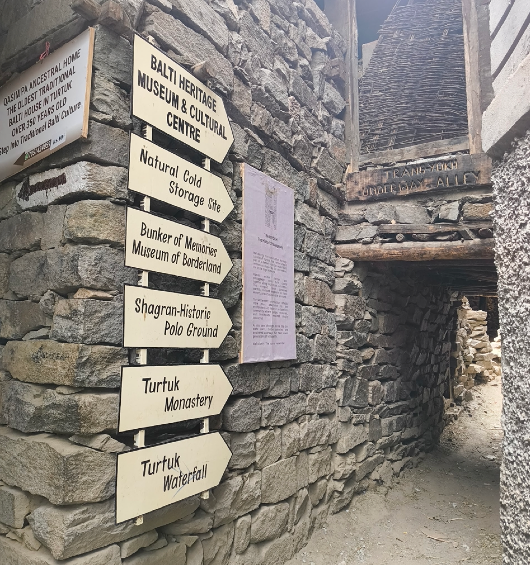
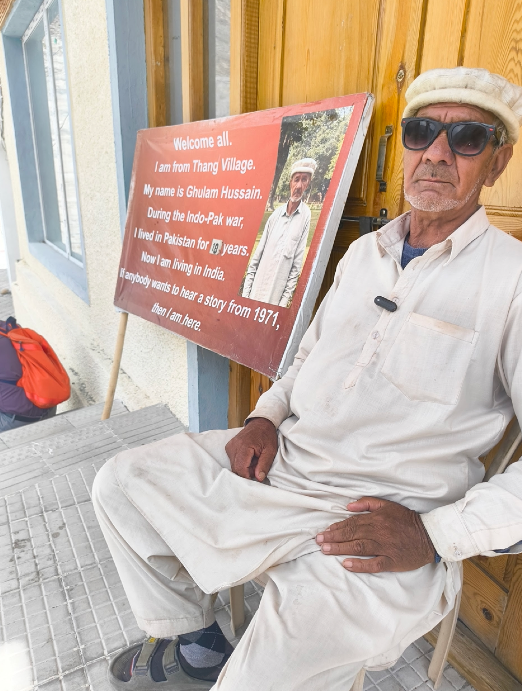
Their identity cannot therefore be judged by either their location close to Pakistan-controlled Baltistan and their emotional attachment with the people across the LoC, or their current status as Indian citizens. The two realities coexist. Almost all the families in Turtuk, especially the last village, Thang, has a family member on the other side of the border. Goba Ali, who was the head of the village Thang till last year is a larger-than-life character in Thang. He came to Thang as a kid to rear cattle’s and in 1971 when Indian forces wrested control of Thang, his parents were left on the other side of the village, Frono, in Ganche district. It has to be noted that Frono was the main village before 1971 and Thang, as told by locals, was just an outpost in the vicinity of the village to rear cows and cattle. The old buildings in the village that still exist tell the story of the past. Goba Ali managed to visit his parents in Frono, and has now converted his house into a museum where he proudly displays the photos of his visit and also how Indian soldiers brought the villages under Indian control in 1971.
The historical Chorbat region extends along the Shyok River between Baltistan and Ladakh. Thang lies at the eastern end of this cultural-geographical zone and is inhabited predominantly by Balti-speaking people who share linguistic and cultural affinities with an area known historically as Baltistan. As stated earlier, Thang village is situated in the historical Chorbat region (or Chorbat Valley) of Baltistan. Along with Bogdang, Chalunka, Turtuk, and Tyakshi, Thang forms part of the Indian territorial portion of the traditional Chorbat valley, which was divided by the ceasefire line and later the Line of Control after the 1971 war.
The Sofia Noorbakshia: A Distinct Sufi Heritage
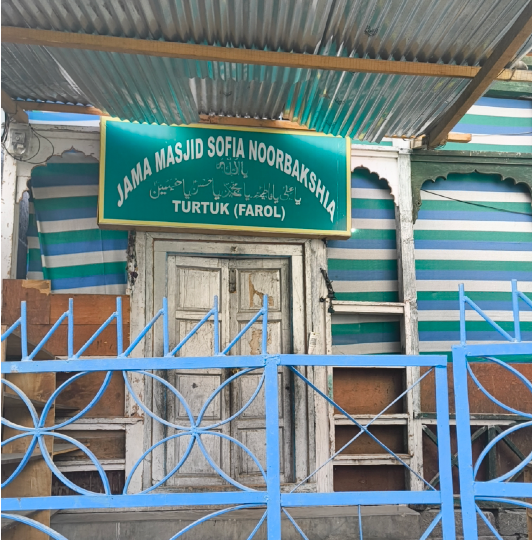
Those living in the Chorbat valley were mostly followers of a unique form of Islam known as the ‘Sofia Noorbakshia’, also written as Nūrbakhshiya, Nurbakhshia or Nurbakhshi. The Chorbat Valley, in Ghanche District in Pakistan Occupied Gilgit Baltistan and in the Turtuk area on Indian side of LoC, has one of the important surviving concentrations of Noorbakshias. Unlike the much larger Sunni, Twelver Shi’a and Ismaili traditions of the wider region, the Noorbakshias regards themselves as belonging to an independent Sufi Islamic tradition, drawing upon both Sunni and Shi’a jurisprudential traditions while placing particular emphasis upon Sufi spirituality. This centuries-old Islamic Sufi order formed the cultural and spiritual backbone of Baltistan. What makes the valley and its people particularly interesting is that the Noorbakshi identity here is not merely a matter of theology. It is intertwined with Balti language, mountain agriculture, village institutions, kinship, khānqāhs and the historical relationship between Baltistan and Ladakh. The valley is therefore an important surviving cultural landscape of this unusual Islamic tradition. It is also emphasised by the people there that the Noorbakshi communities have maintained their distinct identity despite sustained Sunni and Shi’a missionary activity.
The Noorbakshia movement takes its name from Mir Sayyid Muhammad Noorbaksh Qahistani (1392–1464/65), a fifteenth-century Sufi scholar associated with the Kubrawi mystical tradition. He was initiated into the Kubrawi-Hamadani Sufi order by Khwaja Ishaq Khuttalani in 1417 and subsequently became an important spiritual teacher in his own right. This history is significant because the Islam that eventually became deeply rooted in Baltistan was not initially introduced simply through an orthodox Sunni or Shi’a missionary movement. Sufi networks were fundamental to the Islamisation of the region. Sayyid Ali Hamadani (1314-1384) had already played an important role in establishing Islam in the wider region in the late fourteenth century. The Noorbakshi movement subsequently inherited and developed this Sufi legacy. The Noorbakshias consequently see themselves as connected to the older Kubrawi-Hamadani spiritual chain.
The political authorities of fifteenth-century Iran and Central Asia regarded Noorbaksh’s growing religious influence with suspicion. He was imprisoned and exiled for a considerable period. His movement nevertheless survived and spread towards Kashmir, Baltistan and Ladakh. The Nūrbakhshiya subsequently became particularly durable in Baltistan. In Kashmir, by contrast, it was progressively absorbed into the dominant Sunni and Twelver Shi’a traditions. Baltistan therefore became one of the principal places where the tradition survived as a distinct religious identity.
After retrieval of five villages in the Chorbat valley by India in 1971, for the first time the Noorbakshias came directly under the Indian administration. At present, they are under the UT Ladakh administration and beside the Turtuk area they are also settled in various other parts of the region like Drass and parts of Kargil. During a recent field study in Turtuk, this author gathered that there are around ten thousand Noorbakshias in Ladakh— almost four thousand in Bogdang (Nubra area), fifteen hundred in Turtuk, one thousand in Partapur and the rest scattered in Drass and Kargil districts. Interestingly, according to local Noorbakshias they are also settled in many parts of Uttarakhand like Uttarkashi, Vikas Nagar and Nanitaal. Most of them have migrated to this side from Shigar district in Baltistan before partition for labour work, while some of them came for education purpose to Lucknow, but were left on the Indian side after partition. The people of Turtuk look at these people as fellow Baltis and as their own. Some of them have been making efforts to preserve their culture in Uttarakhand which according to them is getting lost by the influence of the region’s prevalent culture.
Demands for Political Representation and Language Preservation
The Noorbakshias are a unique micro community in India. Although they are part of Ladakh, they claim that there is no fair representation for them either in the hill council or in the assembly or Parliament. The Noorbakshia tradition adds another important dimension to their overarching Balti identity. The Balti residents of the Turtuk region, with majority of them being Noorbakshias, have raised concerns about their representation within Ladakh's political institutions, including demands for greater representation of the Balti population in the Hill Council. Such concerns demonstrate that integration of the region into Ladakh is not simply a question of roads and infrastructure. People also need to feel that their voices are represented in institutions that make decisions affecting their lives.
Questioning the symbolic reservation of 24 seats for the people of PoK in the Kashmir Assembly, the overwhelming population of Noorbakshias of Turtuk feel that the government of India should give due representation to the Balti Noorbakshias of Ladakh. There is a strong demand from the community to preserve its culture and Language. The Balti Association Leh (BAL) claimed that it had submitted a memorandum to the Lieutenant Governor of Ladakh to declare Balti Language as one of the Official Languages of Ladakh. The director of BAL Ghulam Mehdi Shah feels that the inclusion of the Balti language and recognizing it as one of the official languages of Ladakh will play a crucial role in preserving and protecting this unique indigenous tribal community. He argued that of all the languages in Ladakh, Balti is the oldest and noted that all Marsiya and Noha during Moharram in Ladakh and Baltistan are said in Balti language. Interestingly, he noted that during the Ladakhi new year celebration, Losar, the folk songs (junglus) are also performed in Balti.
Even centuries after conversion into Shia, Sunni and Noorbakshia sects, the people of the terrain retained their Tibetan-derived Balti language. Religious practices were Islamised, but the language of devotion remained indigenous. Thus, the lamentation poetry of Muharram is expressed not in Arabic, Persian, or Urdu, but in Balti, making the Karbala narrative emotionally accessible to local communities. Balti language serves as a repository of historical continuity. Losar is a pre-Islamic, Tibetan cultural tradition associated with the New Year. The continued performance of junglus in Balti during Losar demonstrates the persistence of older cultural layers beneath subsequent religious transformations. Even when theological orientations changed, language preserved older forms of collective expression. It is important to note that the same Balti language mediates diverse identities. A Balti villager may participate in Muharram commemorations as a Noorbakshia or Shia Muslim and also celebrate aspects of Losar as a bearer of Balti cultural heritage. The common denominator is not religion but language. Balti therefore acts as a bridge connecting Islamic religious identity with a deeper Tibetan-Balti cultural past.
This leads one to conclude that while the religious landscape of Baltistan and the Chorbat-Turtuk region has been profoundly shaped by Islam, the linguistic medium of collective expression has remained distinctly Balti, which suggests that language functions as a deeper marker of identity than religious affiliation, preserving historical continuities that link contemporary Muslim communities to their Tibetan-Balti cultural heritage. This phenomenon is a powerful example of how cultural memory survives political change, religious transformation, and border-making, making Balti language an enduring carrier of identity in the borderlands of Ladakh and Baltistan.
There are approximately thirteen Lakh Balti speakers in India according to BAL and some Baltis, as already mentioned, have settled in parts of Uttarakhand and Himachal Pradesh. There is a strong demand to include Balti as an official language under the sixth schedule. It has to be noted that the Noorbakshias do not have a central institution in India, like the Sunni or the Shia Muslims, even though recently they have managed to open a Madrasa for Sofia Noorbakshias in Dehradun in order to preserve their culture. There is a strong demand for preservation and reservation among this community in Turtuk.
In a region where religious and cultural identities are often viewed through broad categories such as “Muslim” or “Buddhist”, the distinct religious traditions of communities such as the Noorbakshias deserve greater scholarly and public attention. The preservation of their religious practices, oral traditions, language and cultural memory is therefore not opposed to integration with India. Rather, it can become an important part of India's plural social and cultural heritage.
The objective should be to ensure that the people of Turtuk experience full benefits of citizenship while retaining the cultural characteristics that make their community distinctive. This is particularly important because Turtuk occupies a strategically sensitive location. The village lies close to the Line of Control and is part of a wider region that has considerable significance for India's national security. Yet border security cannot depend exclusively on military infrastructure. The long-term strength of a border region also depends upon the confidence, prosperity and participation of its civilian population. A community that has good roads, reliable communications, quality education, healthcare, employment opportunities and meaningful political representation is better positioned to participate in the development and security of its region.
Socio-Economic Realities and Sustainable Tourism
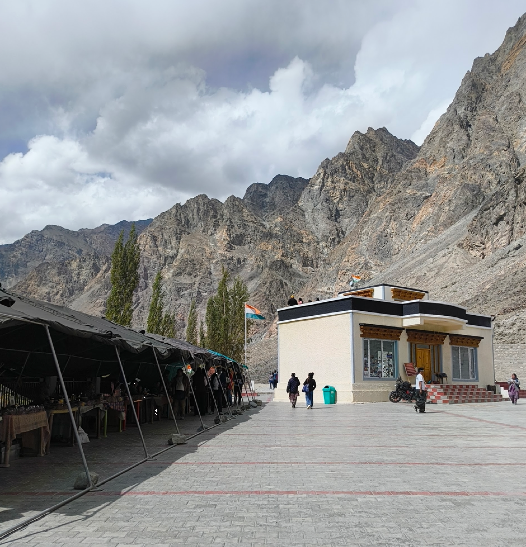
Proximity to national frontiers also functions as a source of emerging economic opportunities for local borderland residents. There has already been considerable change. Turtuk, once largely inaccessible to outsiders, was opened to tourists in 2010. Tourism has created opportunities through homestays, local enterprises and the promotion of Balti culture. The last village Thang, which was not open to tourist four years earlier is now accessible to everyone except foreign tourists. An interesting fact about Thang village is that the donkeys here are costlier than any car and almost all the houses possess them. It has to be noted that almost all the men of the village use these donkeys to drop supplies for the Indian army posts on the higher mountains. But currently, this village has been opened to tourists and there is a kind of chaotic tourism taking place, which has overwhelmed this so-called last village on the LoC. This might impact the security situation if not regulated properly.
Tourism can be valuable, but an excessive dependence on tourism could make the community vulnerable to seasonal fluctuations and environmental pressures. Local cooperatives, agricultural processing, handicrafts, cultural enterprises and digital connectivity could provide more sustainable sources of income. Women should be central to this process. In a remote border community, women’s participation in education, entrepreneurship, tourism, handicrafts and local decision-making can significantly strengthen household and community resilience. Any development programme for Turtuk should therefore examine not only the needs of the community as a whole but also the specific experiences of women and younger generations.
Perhaps the most important requirement, however, is ‘recognition’. Turtuk should not be viewed merely as India's “last village” or as a strategic location on a map. It is a living cultural landscape. Its Balti language, Noorbakshia religious tradition, traditional houses, agricultural practices, oral histories and memories of the 1971 transition constitute a heritage that deserves documentation and preservation. It has to be noted that the Balti community in Turtuk (both Turtuk Yul and Farol), and all other five Balti villages live deeply immersed in the Balti culture and language and the memory of their relatives who live on the other part of Baltistan under occupation by Pakistan. The shops and hotels in Turtuk are named after the villages in Baltistan in PoK and in fact, in Turtuk Farol, there is a whole community of people who came from Kharmang district now in Baltistan and still considers themselves as part of Kharmang. Documenting and integrating these people mentally into India should be made a priority.
There is also a larger national significance to this. India's strength in border regions cannot be measured only by the presence of soldiers or infrastructure. It can also be measured by whether citizens living in difficult and remote environments feel connected to the country's institutions, opportunities and democratic processes. Turtuk provides a powerful example of this principle. Its people have experienced one of the most unusual transformations of citizenship in South Asian history: their homes remained where they were, while the political boundary changed around them.
Conclusion: Integration Without Assimilation
More than five decades after 1971, the challenge is no longer simply to secure the border. It is to build a deeper relationship between the border community and the Indian state—one based on citizenship, development, representation and mutual trust. For this reason, integrating Turtuk into the Indian mainstream should not mean asking the Noorbakshia or Balti community to become culturally indistinguishable from other parts of India. The opposite approach may be more productive: India can strengthen its relationship with Turtuk precisely by recognising and protecting what makes the community distinctive. Turtuk's future therefore lies not in choosing between its Balti identity and its Indian citizenship. It lies in allowing the two identities to coexist.
The village can remain proudly Balti, religiously Noorbakshia and culturally connected to its historical homeland of Baltistan, while simultaneously becoming more deeply connected to India's educational institutions, economy, democratic structures and national life. In that sense, Turtuk should not be seen simply as the “last village” of India. It should be seen as a bridge between India's national identity and the extraordinary cultural diversity of its borderlands. The contemporary challenge is consequently one of integration without assimilation. The future of Turtuk will ultimately depend upon whether its residents are able to experience Indian citizenship not merely as a territorial fact, but as a lived reality of opportunity, representation, security and dignity—while retaining the cultural heritage that has defined the community for generations.
*Dr Zainab Akhter is a Research Fellow at Centre for Peace Studies, New Delhi. The views expressed are her own.
[1] He was a major, commanding forces in the Partapur Sector in Nubra Valley.