

Building Resilient Relations: People as Stakeholders
 As part of the CPS Peace Dialogue, the Centre for Peace Studies (CPS), in collaboration with the India International Centre (IIC), organised a special talk by H.E. Riaz Hamidullah, High Commissioner of Bangladesh to India, on 17 August 2026 at the India International Centre, New Delhi. Titled “Building Resilient Relations: People as Stakeholders,” the session was chaired by Dr Ashok Behuria, Chairman, Centre for Peace Studies. The event continued the CPS Peace Dialogue’s broader engagement with questions of regional peace, stability and shared destinies, bringing together
 diplomats, academics, practitioners and members of civil society to reflect on the future of India-Bangladesh relations. The discussion explored the bilateral relationship from the perspective of people-to-people engagement, emphasising that its resilience cannot rest exclusively on governments, trade, connectivity projects or formal diplomatic mechanisms.
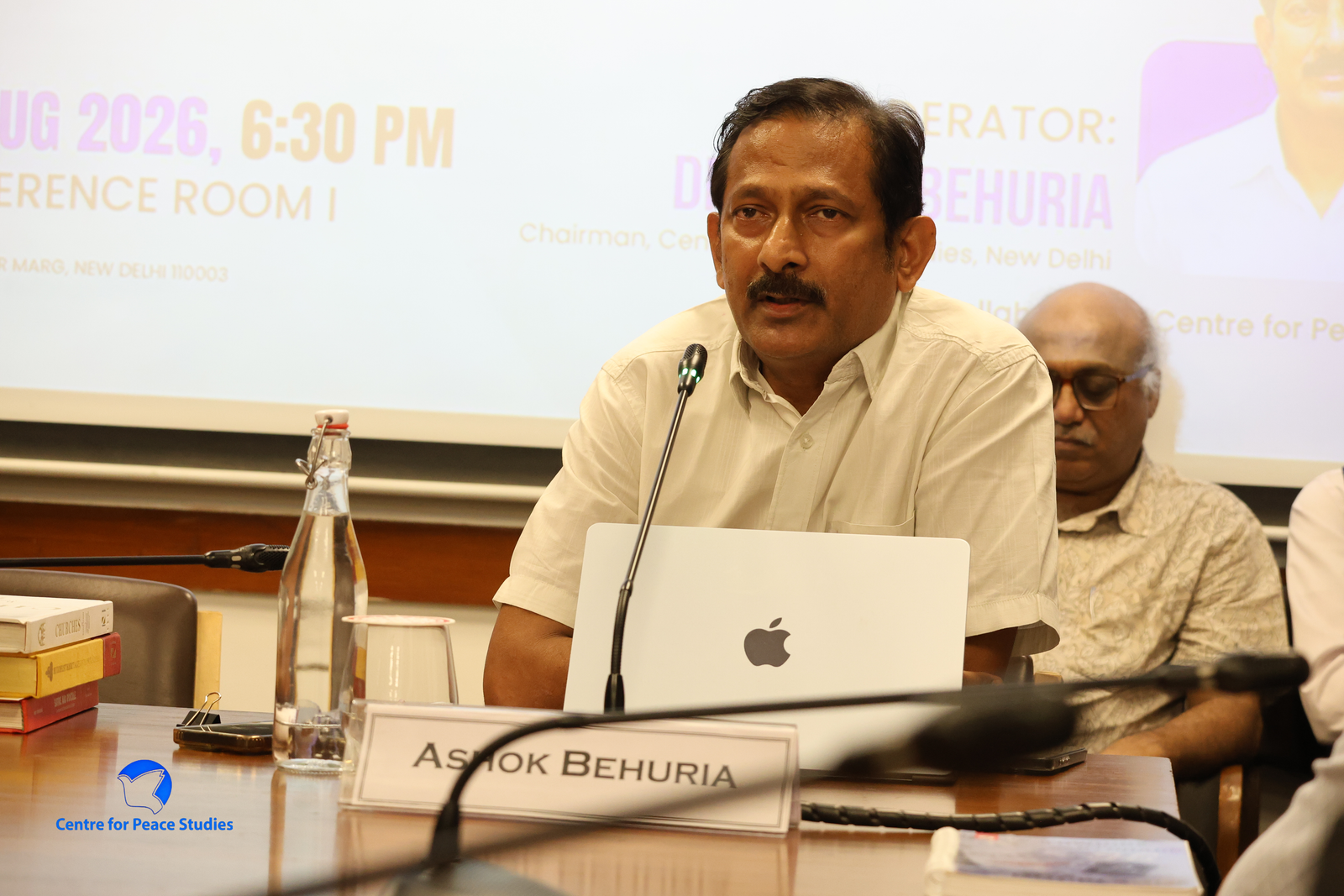
 In his opening remarks, Dr Behuria situated the relationship within the deeper geography, history and social connections shared by India and Bangladesh. He observed that the bilateral relationship is fundamentally different from a conventional state-to-state relationship. “It is not simply a relationship between two governments, two foreign offices or two sets of policy makers sitting across the table. It is a relationship stitched together by rivers that do not recognise and respect borders, by families that live on either side of a line drawn in 1947 and again in 1971. It is also stitched together by languages, literature, music that flow effortlessly across the frontier and by a shared struggle for liberation that remains to this day one of the most moving chapters of our shared modern history.”
 Dr Behuria acknowledged the considerable expansion of bilateral trade, connectivity, infrastructure, power-sharing and transport links over the past decade, while cautioning against treating these indicators as the sole measure of the health of the relationship. Against the backdrop of recent political turbulence, he argued that greater attention must be paid to the social foundations of the relationship. “As global economic uncertainties, climate vulnerabilities and rapid technological shifts reorder our world, the resilience of India-Bangladesh relationship will increasingly depend on how effectively we insulate ourselves from vicissitudes of political change at the internal level in both countries, and empower the people of both sides of the border to drive cooperation uninterruptedly, unaffected by such changes.”
He further emphasised that students, patients, traders, families and border communities continue to sustain links even during periods of political uncertainty. “Resilience, I would insist, is ultimately not an attribute of treaties and trade relations. It is an attribute of the people.” He also noted that political governments and policy orientations can change, whereas social relationships, when nurtured, can withstand periods of political turbulence.
 The High Commissioner Hamidullah described his intervention as a conversation grounded in his experiences as a practitioner. Reflecting on his experience of more than a year in New Delhi, he said that the people of both countries did not know each
  other well and argued that perceptions are often shaped by inherited assumptions and outdated frameworks. “I don’t think we really understand, where is the accent on people, and where should be the accent on people,” the High Commissioner remarked.
 A major theme of his address was the changing social landscape of South Asia in general and India and Bangladesh in particular. Hamidullah highlighted the significance of youth, urbanisation and technology in reshaping aspirations and patterns of interaction. Younger generations are increasingly connected through digital platforms even when formal institutions and conventional diplomatic mechanisms struggle to keep pace. He suggested that generational change is occurring much faster than traditional policy frameworks recognise, creating a need to understand contemporary social realities rather than relying exclusively on older studies and assumptions.
 The High Commissioner also urged audience through them the policymakers to look beyond administrative boundaries when thinking about people and communities. He put it figuratively by saying that we needed to move “from politics to poetry” and “from culture to agriculture”. He argued that identities and livelihoods are often shaped by agro-ecology and geography as much as by political or administrative divisions. This perspective led him to propose agriculture, health and learning as areas in which India and Bangladesh could develop more meaningful forms of collaboration. He distinguished between cooperation and collaboration, arguing that the two countries remain overly comfortable with the former. “We are stuck more in terms of cooperation, not collaboration.”
 Agriculture, in particular, was presented as an underexplored area of bilateral engagement. Hamidullah drew attention to small and marginal farmers and questioned why they remain insufficiently visible in discussions about bilateral stakeholders. “Who else could be better stakeholders?” he asked, arguing that collaboration around agriculture, water use, health, education and local economies could directly benefit communities on both sides.
The High Commissioner also challenged the tendency to assess India-Bangladesh relations primarily through trade figures. While acknowledging the importance of economic relations, he argued that the deeper relationship rests on shared social and cultural values. “We are connected, less by interest, but more by values.” Cultural engagement, therefore, should not be viewed merely as an instrument of soft diplomacy. Recounting his efforts to connect artists, musicians and cultural practitioners, Hamidullah stated, “In the difficult times that we were navigating, I said, that is the way to bring people, connect people, and create conversation. My own game was conversation, not soft diplomacy.”
He cited border haats, cultural programmes, films, short-story festivals and academic collaboration as practical ways of creating such conversations. His observation about border haats captured the broader philosophy of his intervention: these spaces are not only sites of commercial exchange but also of social interaction and emotional connection. He noted that people often use them to sustain relationships with relatives and communities across the border, describing them as “more, if not equally, about trading emotions, than goods.”
 In his concluding reflections, Hamidullah returned to the relationship between society, economy and ecology. He stressed the importance of historical memory while cautioning against allowing the past to determine the possibilities of the future. “Past is very crucial. But, tomorrow will be another day, and that tomorrow, may not be necessarily conditioned by yesterday, past.”
The discussion highlighted the need to rethink India-Bangladesh relations around people, shared values, ecological interdependence and emerging aspirations. Rather than viewing people-to-people engagement as a supplement to formal diplomacy, the session presented it as a means of making bilateral relations more resilient to political fluctuations.
This report has been prepared by Faiza Rizwan, a Junior Research Analyst at the Centre for Peace Studies, New Delhi.
Glimpses From the Event

|
|
|---|---|
 |
 |
 |
 |
 |
 |